
Git Branching Strategies: Discover Your Best Approach
Finding the perfect git branching strategy

In the fast-paced world of software development, selecting the right Git branching strategy can greatly influence your team’s efficiency and code quality. With various methods available—each designed for different workflows and team dynamics—it's essential for developers to understand these strategies. This post will explore two effective Git branching strategies, helping you identify which one best aligns with your project needs and team structure. It's important to note that there is no perfect branching strategy; each comes with its trade-offs. Ultimately, finding the right approach can enhance your development process and streamline collaboration.
Trunk-Based Development
Trunk-based development is a version control strategy where everyone works on a single main branch, called the "trunk." Instead of long-lived feature branches, developers frequently commit small changes directly to the trunk, keeping the code always ready for deployment.
If feature branches are used, they don’t last long—usually just a few hours or days before merging back into the trunk. This reduces merge conflicts, makes continuous integration smoother, and ensures fast feedback. The goal is to keep the main branch production-ready at all times, with developers constantly committing and testing their changes.
Trunk-based development is great for teams that prioritize fast releases and continuous delivery (CI/CD). It simplifies branch management and encourages close collaboration since team members need to communicate regularly to stay in sync.

Challenges
Although this strategy is simple, it comes with some challenges. Since developers often merge incomplete features into the trunk, feature flags become a must to keep things stable. Trunk-based development also relies heavily on automated testing to catch bugs quickly. With frequent merges, the risk of introducing bugs is higher, so having a solid testing setup is key to maintaining a stable codebase.
For larger teams, managing constant merges in trunk-based development can be tricky. More developers working on the same branch means more potential conflicts, and keeping everything coordinated requires regular communication. If changes aren’t well-aligned, the trunk can become unstable.
Who is this strategy for?
Trunk-based development works best for teams that need speed and agility. It’s a great fit for small, collaborative teams where developers can easily coordinate their changes. Startups, DevOps-driven teams, or any organization with solid CI/CD and rapid releases will find this strategy particularly useful.
Feature Branching
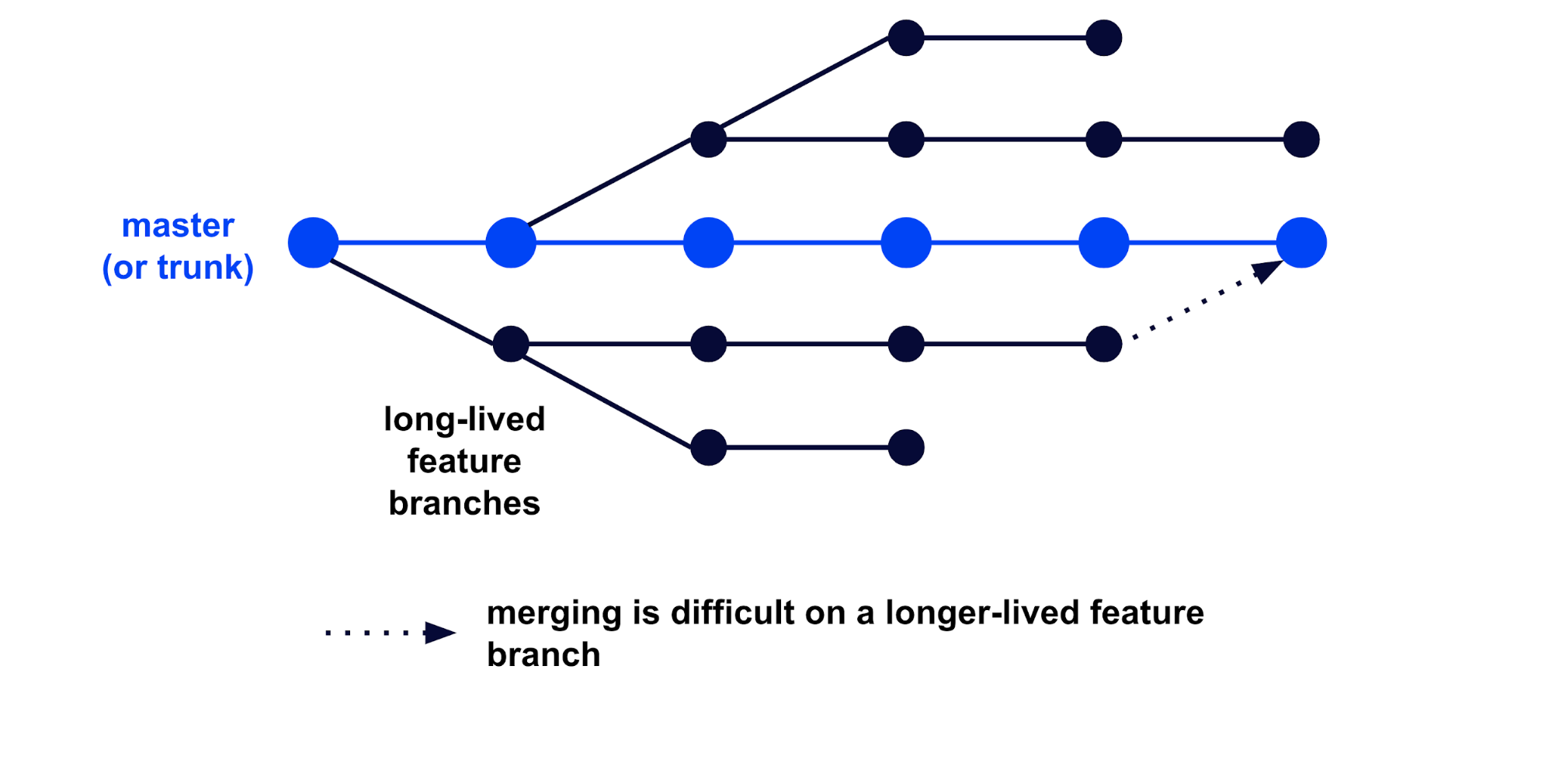
Feature branching is another popular version control strategy where developers create separate branches for each new feature they’re working on. Instead of committing changes directly to the main branch, they develop and test their work in isolation. Once the feature is ready, it’s merged back into the main branch, often through a pull request.
This method gives developers a safe space to work on complex or experimental features without worrying about breaking the main codebase. It also makes code review easier since the isolated branch can be shared for feedback before merging.
Challenges
While feature branching arguably makes development easier, testing and integration can be more challenging. Since features are developed in isolation, it’s harder to predict how they’ll interact with other changes when merged back into the main branch. The longer a feature branch exists, the more likely it is to have merge conflicts, making integration tricky. To minimize these risks, it’s important to keep feature branches short-lived, merge often, and have strong testing practices.
Who is this strategy for?
Feature branching is particularly suited for teams and projects where features require significant development time or complexity. It is ideal for organizations that prioritize maintaining a stable production environment, as it allows developers to work on new functionalities without affecting the main codebase. This strategy works well for larger teams, as it enables collaboration on multiple features simultaneously while providing clear isolation for individual work.
Git Flow Workflow
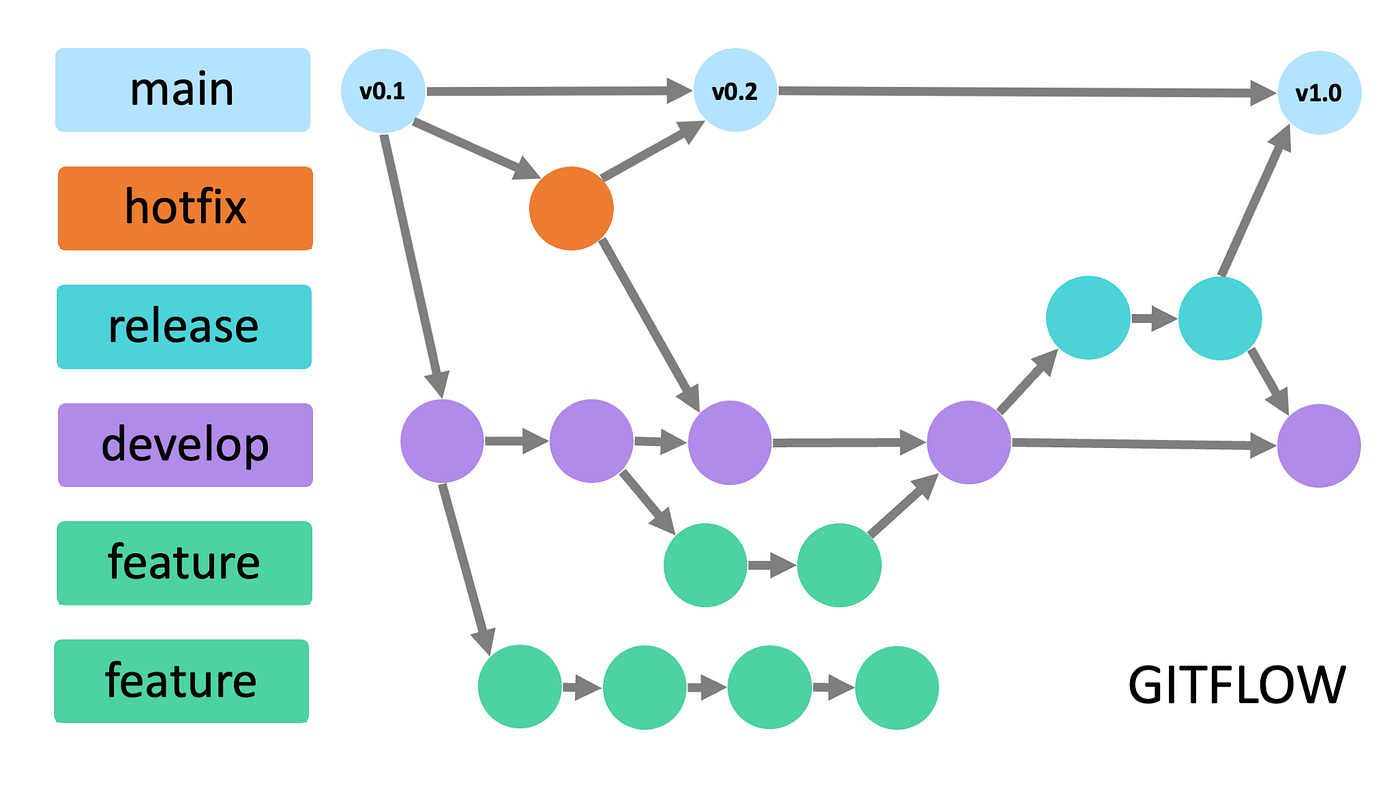
Git Flow makes feature branching more organized by breaking things down into specific branch types: master, develop, feature, release, and hotfix—each with a clear role. The main branch is where all the production-ready, stable code lives. The develop branch is like the main working branch, where developers bring together all their new features before they’re released. Feature branches are created for individual features, so developers can work on them separately without impacting the rest of the code. Once a release is ready, a release branch is used to clean up, fix bugs, and finalize the code for deployment, while development continues in parallel. Then there’s the hotfix branch, which is a quick way to fix any urgent issues that pop up in production—patches can go straight from master without having to wait for the next feature update.
This structure really helps teams stay organized, especially when multiple features are being worked on at the same time. It keeps everything clear about where changes should be made and helps avoid the confusion that can come with complex projects. Plus, it makes sure the production code stays stable while still allowing for continuous development.
Scaled Trunk-Based Development
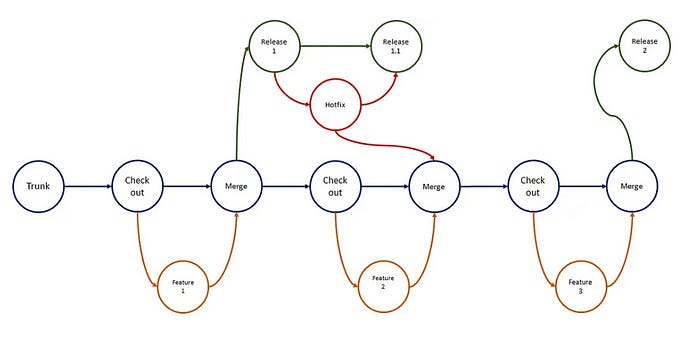
Scaled trunk-based development takes the core idea of trunk-based development—frequent, small changes to a single main branch—and adds key elements from Git Flow to make it more manageable for larger teams. Borrowing from Git Flow, this approach introduces short-lived branches for specific tasks like features, releases, or hotfixes, but emphasizes merging back into the trunk quickly. This allows teams to keep the benefits of continuous integration without the long-lived feature branches that can create merge conflicts and slowdowns. The structured use of release and hotfix branches, inspired by Git Flow, adds a layer of organization, ensuring stability while keeping development fast and efficient. By incorporating these elements, scaled trunk-based development creates a balance between speed and structure, helping larger teams stay in sync without sacrificing the production readiness of the trunk.
What strategy should you choose?
Ultimately, the best branching strategy depends on your team size, project needs, workflow, and preference. Small teams might prefer trunk-based development for its simplicity and speed, while larger teams could benefit from the structure of Git Flow and feature branching. It’s also important to regularly evaluate your strategy to ensure it aligns with your current goals. As projects and teams evolve, your approach may need to shift to keep things running smoothly.